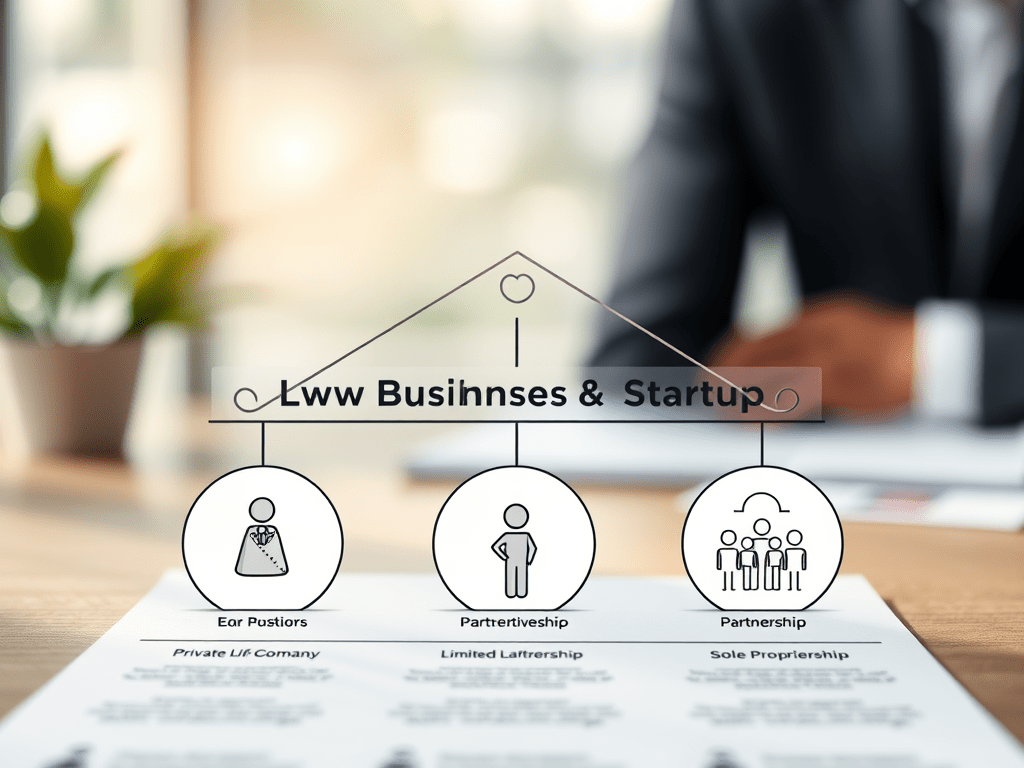
Starting a business is an exciting journey, but one of the most critical decisions founders face is choosing the right business structure. This choice impacts legal liability, taxation, regulatory compliance, ability to raise capital, and long-term growth potential. In India, the most common business structures include Private Limited Company (Pvt Ltd), Limited Liability Partnership (LLP), Partnership, and Sole Proprietorship. Each structure has distinct features, advantages, and disadvantages, making it essential to align the choice with business goals, industry type, and operational needs.
This article offers a comprehensive guide for founders in India, helping them navigate the maze of business structures by defining each type, exploring suitable business scenarios, and comparing compliance and tax benefits.
Sole Proprietorship
Definition:
A Sole Proprietorship is the simplest form of business structure, where a single individual owns, manages, and is fully responsible for the business.
✔️ Suitable Business Types:
- Small retail shops
- Freelance services (graphic design, content writing, consulting)
- Small-scale trading or manufacturing
- Home-based businesses
Key Features:
- Single owner and decision-maker
- Minimal formal registration required (often under local municipal licenses or GST)
- No separate legal entity – owner and business are legally the same
Compliance Benefits:
- Minimal compliance requirements
- No mandatory audit unless turnover exceeds a threshold (e.g., ₹2 crore)
- Simple GST and income tax filing
Tax Benefits:
- Income taxed as personal income of the owner
- Lower compliance cost compared to companies
- Losses can be offset against other personal income (subject to IT rules)
Limitations:
- Unlimited personal liability
- Difficulty raising funds from investors
- Limited scalability
2. Partnership Firm
Definition:
A Partnership Firm involves two or more individuals (partners) jointly conducting a business under a partnership deed, sharing profits, losses, and management responsibilities.
Suitable Business Types:
- Law firms
- Accounting and auditing firms
- Small-scale manufacturing and trading businesses
- Family businesses
Key Features:
- Governed by the Indian Partnership Act, 1932
- Requires a Partnership Deed (though not mandatory, it is highly recommended)
- Partners share liability and decision-making as per the deed
Compliance Benefits:
- Moderate compliance: Filing of partnership deed, GST registration (if applicable), and annual income tax returns
- No requirement of statutory audit unless turnover exceeds thresholds
- Less regulatory burden compared to companies
Tax Benefits:
- Taxed under the Income Tax Act as a separate entity at a flat rate of 30% plus applicable surcharge and cess
- Partners are taxed on their share of profits in the firm
- Tax advantage in profit-sharing flexibility
Limitations:
- Unlimited liability for partners
- Difficulty in raising external capital
- Dissolution risk if a partner exits
3. Limited Liability Partnership (LLP)
Definition:
An LLP combines the operational flexibility of a partnership with the limited liability feature of a company. It is governed by the Limited Liability Partnership Act, 2008.
Suitable Business Types:
- Consulting firms
- IT services and software development companies
- Professional services (legal, financial advisory)
- Startups requiring flexibility but legal protection
Key Features:
- Separate legal entity
- Partners have limited liability (limited to their contribution)
- No restriction on the maximum number of partners
Compliance Benefits:
- Annual filing of financial statements with the Ministry of Corporate Affairs (MCA)
- No requirement for audit unless turnover exceeds ₹40 lakh or capital contribution exceeds ₹25 lakh
- Easier compliance compared to a private limited company
Tax Benefits:
- Taxed as a partnership firm at 30% plus applicable surcharge and cess
- No dividend distribution tax (unlike companies)
- Losses can be carried forward
Limitations:
- Cannot raise equity capital from public investors
- Restricted to private funding sources (partners’ capital or private investors)
- Not suitable for large-scale business needing complex structures
4. Private Limited Company (Pvt Ltd)
Definition:
A Private Limited Company is a separate legal entity governed by the Companies Act, 2013. It offers limited liability, shareholding structure, and compliance obligations, ideal for businesses planning large-scale operations or seeking external investments.
Suitable Business Types:
- Tech startups
- Manufacturing enterprises
- E-commerce companies
- Service-oriented businesses seeking scalability and funding
Key Features:
- Minimum 2 and maximum 200 shareholders
- Directors are required for corporate governance
- Shares are not freely transferable
- Separate legal identity from owners
Compliance Benefits:
- Mandatory annual filing of financial statements, board resolutions, and annual returns with the MCA
- Statutory audit mandatory regardless of turnover
- Strong corporate governance framework
- Well-recognized by investors and banks
Tax Benefits:
- Taxed at 22% (plus surcharge and cess) for newly incorporated domestic companies opting for the concessional tax regime
- Dividend Distribution Tax (DDT) abolished, dividends taxed in the hands of shareholders
- Ability to raise funds through equity shares, venture capital, or private equity
Limitations:
- Higher compliance cost
- Complex regulatory framework compared to LLP or Partnership
- Stricter governance norms (Board Meetings, Annual General Meetings, etc.)
Comparative Overview of Business Structures
| Parameter | Sole Proprietorship | Partnership | LLP | Private Limited Company |
|---|---|---|---|---|
| Liability | Unlimited personal liability | Unlimited personal liability | Limited to contribution | Limited to shareholding |
| Legal Entity | Not separate | Not separate | Separate legal entity | Separate legal entity |
| Compliance | Minimal | Moderate | Moderate | Strict |
| Taxation | Personal income tax | Flat 30% + surcharge & cess | Flat 30% + surcharge & cess | 22% (plus cess, optional regime) |
| Investment Raising | Difficult | Difficult | Limited to private funds | Easy (Equity, VC, PE) |
| Scalability | Low | Low | Medium | High |
| Suitable For | Freelancers, small traders | Professional services, small businesses | Consulting, IT services | Tech startups, manufacturing, high-growth enterprises |
What Should Founders Pick?
Choosing the right business structure depends on the startup’s vision, scale, sector, and long-term strategy:
- A Sole Proprietorship suits freelancers or small traders with minimal compliance and low capital needs.
- A Partnership Firm works well for professional services but lacks liability protection.
- An LLP is ideal for service-based startups needing limited liability without heavy compliance.
- A Private Limited Company is the best choice for high-growth startups seeking funding, strong credibility, and scalability.
Founders must balance liability protection, compliance, tax efficiency, and growth potential when making this critical decision. Consulting legal and financial advisors is advisable to tailor the choice to specific business goals.
By selecting the right structure, startups can create a solid foundation for success in India’s dynamic business environment.
If you enjoyed reading this article, then here are 20 MCQ questions based on the topic of choosing the right business structure in India, along with correct answers and brief explanations:
What is the simplest form of business structure in India?
A) Private Limited Company
B) Partnership Firm
C) Limited Liability Partnership (LLP)
D) Sole Proprietorship
Answer: D) Sole Proprietorship
Explanation: A Sole Proprietorship is the simplest and easiest structure to set up, with minimal regulatory requirements.Which business structure provides limited liability to its owners?
A) Sole Proprietorship
B) Partnership
C) LLP
D) None of the above
Answer: C) LLP
Explanation: An LLP provides limited liability protection, meaning partners are liable only up to their agreed contribution.
What is the governing law for a Private Limited Company in India?
A) Indian Partnership Act, 1932
B) Companies Act, 2013
C) LLP Act, 2008
D) Income Tax Act, 1961
Answer: B) Companies Act, 2013
Explanation: Private Limited Companies are governed by the Companies Act, 2013 in India.
What is the maximum number of shareholders allowed in a Private Limited Company?
A) 50
B) 100
C) 200
D) Unlimited
Answer: C) 200
Explanation: A Private Limited Company can have a maximum of 200 shareholders.
Which structure is most suitable for small-scale home-based businesses or freelancers?
A) LLP
B) Private Limited Company
C) Sole Proprietorship
D) Partnership Firm
Answer: C) Sole Proprietorship
Explanation: Sole Proprietorship is ideal for small businesses with low capital requirements and simple operations.
Which business structure allows easier access to venture capital and private equity?
A) Sole Proprietorship
B) LLP
C) Partnership
D) Private Limited Company
Answer: D) Private Limited Company
Explanation: Private Limited Companies are preferred by investors due to their separate legal identity and ability to issue shares.
Which type of business structure requires a Partnership Deed for its formation?
A) Sole Proprietorship
B) LLP
C) Partnership Firm
D) Private Limited Company
Answer: C) Partnership Firm
Explanation: A Partnership Firm is ideally governed by a written Partnership Deed as per the Indian Partnership Act, 1932.
Under which act is a Limited Liability Partnership (LLP) governed in India?
A) Indian Partnership Act, 1932
B) LLP Act, 2008
C) Companies Act, 2013
D) Income Tax Act, 1961
Answer: B) LLP Act, 2008
Explanation: The LLP structure is governed by the Limited Liability Partnership Act, 2008 in India.
What is one key advantage of LLP over Partnership Firm?
A) No compliance required
B) Partners have unlimited liability
C) Separate legal entity and limited liability
D) No tax filing needed
Answer: C) Separate legal entity and limited liability
Explanation: LLP offers a separate legal identity and protects partners from personal liability beyond their contribution.
Which structure does NOT require mandatory statutory audit unless turnover exceeds specific thresholds?
A) Private Limited Company
B) LLP
C) Sole Proprietorship
D) None of the above
Answer: B) LLP
Explanation: LLPs are required to have audits only if turnover exceeds ₹40 lakhs or capital contribution exceeds ₹25 lakhs.
What type of tax is applicable to the income of a Sole Proprietorship?
A) Corporate Tax
B) Partnership Tax
C) Personal Income Tax
D) GST only
Answer: C) Personal Income Tax
Explanation: The income of a sole proprietorship is taxed as personal income of the owner under the Income Tax Act.
Which structure provides the highest scalability and ability to raise funds from the public?
A) Sole Proprietorship
B) LLP
C) Partnership Firm
D) Private Limited Company
Answer: D) Private Limited Company
Explanation: Private Limited Companies can scale by issuing shares and raising equity from investors.
Which structure is best suited for professional service providers like lawyers or accountants?
A) Sole Proprietorship
B) LLP
C) Private Limited Company
D) Partnership Firm
Answer: B) LLP
Explanation: LLP is preferred for professional services due to limited liability and simple compliance.
The key disadvantage of a Sole Proprietorship is:
A) Complex compliance
B) Difficulty in tax filing
C) Unlimited personal liability
D) Separate legal entity
✔️ Answer: C) Unlimited personal liability
Explanation: In a Sole Proprietorship, the owner bears unlimited personal liability for business debts.
Which structure requires the filing of annual returns and financial statements with the Ministry of Corporate Affairs (MCA)?
A) Sole Proprietorship
B) Partnership
C) LLP
D) Private Limited Company
Answer: D) Private Limited Company
Explanation: Private Limited Companies must file annual returns and financial statements with the MCA.
Which business structure is NOT a separate legal entity?
A) Sole Proprietorship
B) LLP
C) Private Limited Company
D) None of the above
Answer: A) Sole Proprietorship
Explanation: Sole Proprietorship is not a separate legal entity from the owner.
For which type of business is a Private Limited Company the least appropriate?
A) High-growth tech startup
B) Small home-based service
C) Manufacturing business with investors
D) Large-scale e-commerce venture
Answer: B) Small home-based service
Explanation: Private Limited Company involves more compliance and cost, which is overkill for small home-based service providers.
Which structure is governed by the Indian Partnership Act, 1932?
A) LLP
B) Private Limited Company
C) Partnership Firm
D) Sole Proprietorship
Answer: C) Partnership Firm
Explanation: The Indian Partnership Act, 1932 governs Partnership Firms.
The main tax benefit of LLP over Private Limited Company is:
A) Higher tax rate
B) Ability to carry forward losses
C) Mandatory dividend tax
D) No separate legal status
Answer: B) Ability to carry forward losses
Explanation: LLPs can carry forward losses as per Income Tax Act provisions, unlike Pvt Ltd companies under certain regimes.
Which business structure offers the best legal protection and investor credibility?
A) Sole Proprietorship
B) LLP
C) Partnership Firm
D) Private Limited Company
Answer: D) Private Limited Company
Explanation: Pvt Ltd Company provides the strongest legal protection, separate legal identity, and is most credible for investors.
 Law School Uncensored
Leave a comment